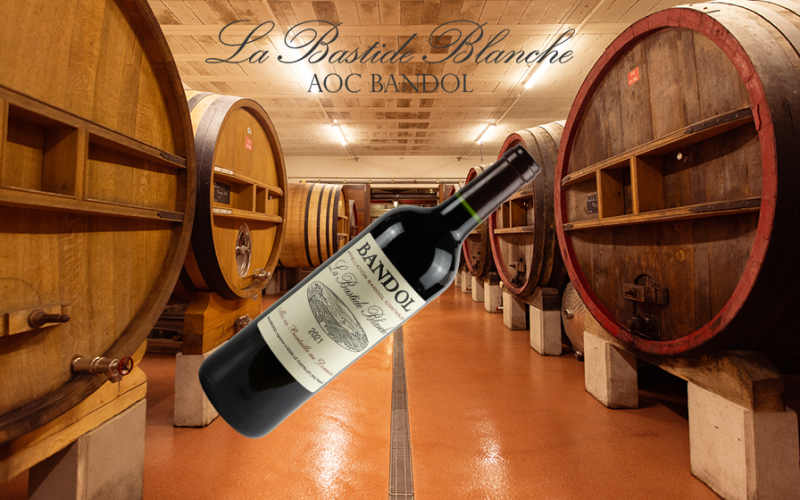
The history of La Bastide Blanche

My name is Nicolas Bronzo. I have been running Bastide Blanche with my brother Julien for a little over ten years. I grew up on the estate, and my brother still lives there. We rarely have the time (or opportunity) to look back, but this year is a bit special as we are celebrating Bastide Blanche’s 50th anniversary. For this occasion, I took the time to sit down and talk with the two people who contributed to making the estate what it is today. I transcribed the results of these interviews as faithfully as possible. Only the notes are my own.

Michel Bronzo and Stephane Bourret
Michel Bronzo, owner.
Note: My father Michel acquired the estate in 1972 with my grandfather, Baptistin, and my uncle Louis. It was a family affair, but from the start, Michel was the one who invested the most in this project. Thanks to him, Bastide Blanche became a well-established domain in Bandol and Provence. Even though officially he handed over the reins to my brother and me several years ago, he still keeps a watchful eye on the estate.
How did you find the estate? Were you specifically looking in Bandol?
We weren’t really searching, but my father was always very attentive to any opportunities that came his way, and he knew a lot of people! One of his contacts told him about a vineyard property for sale in La Cadière. He asked me, ”Are you interested?” I am interested in everything. And in this case even more, because I spent my childhood on a farm where we produced a lot of wine. So we went to see this property. The vines were poorly located, and the estate produced low-quality table wine. I didn’t like that; I wanted to do this out of passion, not just to produce and sell hectoliters of wine. The manager showing us around then mentioned another estate a few kilometers away that might be for sale: it was la Bastide Blanche. The estate produced AOC Bandol, which immediately piqued my interest. We went to take a look, and I immediately liked it. The owner was the widow of an industrialist from Belfort (Note: in the East of France). A well-known producer in Bandol was already courting her to buy her lands. But once my father had made up his mind, he was unstoppable. He proposed to the owner to leave her a small plot amidst the vineyards and to build a custom-made house for her so she could come there from time to time. He convinced her, and we were able to buy the estate. That was in 1972.

What were the main difficulties after the purchase?
Everything had to be done! There was no cellar for winemaking, and the vines were in very bad shape. Out of the ten planted hectares, we had to uproot three immediately. That left only seven hectares in production! For the first year, in 1973, we worked with almost nothing: we bought a 50-hectoliter vat, a crusher, and an old press. Then we had to renovate and replant. Between 1973 and 1981, we managed to plant almost 20 hectares. My father’s tenacity contributed a lot. We planted a lot of Mourvèdre because originally there was very little of it. At that time, a minimum of 20% was required in the red wines of Bandol (Note: now it’s 50%), and we were already at the limit. We had to learn about the terroir, the plots, not to make mistakes in planting grape varieties. We had to learn everything.

And how did you learn?
The first farm manager only stayed for a year: we didn’t get along at all! To replace him, I hired Mr. Pena, a man from Saint-Maximin who was a real old-school farmer, in the best sense of the term. He was really nice, and with him, I learned a lot about vineyard cultivation and even the basics of winemaking. It might sound silly, but he taught me how to properly seal the cask doors. And even today, I allow myself to make remarks when the cask doors are poorly sealed and there are leaks! And then, I also received a lot of advice from some property owners in Bandol, like Lucien Peyraud (Note: from the Tempier estate) or Jean-Pierre Boyer (Note: from the Salettes estate) who helped me a lot during those years, especially with the design and layout of the cellar.
Do you remember the first vintage, 1973?
I remember because I was part of the Appellation’s tasting committee. There was a tasting of all the Bandol wines, and ours came out among the best. I was very proud of myself.
Can you tell us a few words about the label? How was it created? Was it a complicated decision?
I wanted something traditional that would highlight the Bandol appellation because the estate had no notoriety. It was your mother (Note: Jeanne-Marie, deceased in 2020) who drew the landscape in a medallion shape that has become so characteristic. This visual has changed very little over the years, but honestly, it was done somewhat instinctively, without conducting any marketing study.
Winemaking fifty years ago and winemaking today: have things changed a lot?
Honestly, no! Well, at least, not that much! Obviously, technologies have evolved. We now have much more advanced equipment. Winemaking methods have also evolved, for example, regarding destemming. But overall, I find that the fundamental points remain more or less the same. And that has been true for thousands of years: we crush the grapes and press them!
How do you see the Estate and the Appellation in 50 years?
Phew! Tough question! I feel like the world is changing faster and faster. Without a doubt, the world of wine will change more in the next fifty years than it has in the past fifty years. For us, the number one issue is climate change. We might still be able to make wine, but at what cost? With which grape varieties, and what quality? And with what level of alcohol? Today, to get ripe grapes, wines reach between 14 and 15°. That’s already a lot. Who will buy our wines when they reach 16° or more?
Stéphane Bourret, estate manager.
Note: Stéphane graduated from the Oenology School in Montpellier. He joined la Bastide Blanche in 1997. At the time, I used to work at the estate in the summer and for part of the harvest. I was 16, and I must admit he impressed me a bit! Since then, I’ve gotten to know him and appreciate him. He taught me thousands of things about wine. Since his arrival, he has played a major role at la Bastide Blanche. Therefore, it seemed essential to gather his testimony on the estate’s evolution.
Stéphane, when you arrived at La Bastide Blanche in the late ’90s, what was your perception of the estate and of the Bandol Appellation from an outsider’s perspective?
During my studies, we had tasted Bandol wines several times. We had the image of an upscale appellation like Chateauneuf. In red wines, it was among the great wines of the South and the only one from Provence. However, it was very traditional: required a minimum of 10 years of aging and at least 10 hours of decanting! For immediate pleasure, it was complicated. You still needed patience and, above all, to eat at the same time because in pure tasting, it required a well-acclimated palate!
When I found out I had an appointment at Bastide Blanche and that I could potentially ’land’ in Bandol, I bought about ten bottles of red from the appellation, just to see. It was around May-June ’97. I remember a ’93 (I won’t give a name) which, after spitting out the wine, prevented you from salivating and speaking, it was so astringent. A quinine infusion! And they were all like that, except Pibarnon, which seemed more approachable, more elegant.
Honestly, about the Bastide Blanche domain, I had no idea about the style. It was impossible to find bottles where I was. And to get an idea, I would have needed to taste several vintages. I also had no information about the domain and the owners. The person who connected me only said that the establishment was ’solid’ and that the owner was not just an investor but someone involved in the life of the appellation. She also said that he was a strong personality!
It was only during the first interview that I discovered the production. It was in the traditional vein. But there was an overripeness that masked the astringency of the tannins. For me, it lacked acidity. I found the whites heavy, too candied, but with a beautiful aromatic expression.”
Once in place, did you encounter any surprises, or did it resemble what you had imagined?
I arrived on August 18, 1997. Needless to say, I couldn’t have lengthy discussions with Michel before the harvest began. Until then, a lot of emphasis was placed on the consulting oenologist (who incidentally used to work at Bastide Blanche). His recommendations were followed without much questioning.
I had spent 4 years in Bordeaux, where vinification work was crucial, with a lot of focus on aeration, temperatures, etc. In Bandol, once the grapes were in the vat, there were fewer questions asked! They would say, ’With Mourvèdre, you need to be patient. It’s tough, but aging will soften it!’ I was entering an appellation that had a rather elitist image but seemed to have little reflection on vinification methods and possible developments. The same applied to cultivation. It was quite straightforward, without much thought given to pruning, soil work, cover crops… The same methods were applied from one year to the next.
Do you remember your first harvests at Bastide Blanche? Your initial winemaking experiences?
As if it were yesterday! And my wife even more so! You’d start at 4 am and finish at 11 pm. It’s normal to work hard during the harvest, but we spent over 3 hours cleaning the winery at the end of the day. Simple operations required an incredible amount of energy and time. The winery wasn’t very practical, and the people in place weren’t necessarily very motivated.
And then, we had to get accustomed to working with Michel, which took some time! He had a lot of contacts with winemakers from other regions due to his roles at the INAO. He came back from his trips with questions, ideas… We discussed a lot about technical choices and possibilities for evolution. To convince Michel, you had to argue precisely, provide all the information. In the end, he accepted the change, even if sometimes he grumbled a bit. Regarding work in the vineyards, we also had different views initially. I had very clear ideas about the cultivation method: heavily focused on organic and biodynamic principles, biodiversity in the surroundings, soil life. Even though Michel had this same approach, it wasn’t as pronounced. He had a more traditional vision of vine cultivation.
Looking back over nearly 30 years at Bastide Blanche, what perspective do you hold?
Over such a long period, there were inevitably moments of tension. It hasn’t always been easy! But it seems to me that we have progressed. That’s important because if you don’t move forward, you fall behind compared to other domains!
Ultimately, everyone played their role: the family expressing their desires and setting the desired direction, and me suggesting solutions to try to make things evolve or explaining what is feasible or not, useful or not. We maintained the ’artisan’ aspect while producing an average of 200,000 bottles per year. Not an easy feat! If I had to summarize these 26 years: motivating, stimulating, exhausting, and fascinating.
What is the thing you are most proud of?
There have been many positive developments, and I don’t have the pride to think it’s all because of me. It’s difficult to pinpoint just one thing. Perhaps advocating to modify the profile of the wines without losing the domain’s uniqueness. But still, a more personal satisfaction: giving a recognized identity to the domain’s whites.
And what would you do differently if given the chance?
Plenty of things… What? That, I can’t say! And on reflection, maybe not after all! With hindsight, it’s easy to say ’if it were to be done again’… Mistakes shape your experience. You only learn well by making mistakes. The goal, however, is to make as few mistakes as possible!
Every year, I tell myself I missed something, that we didn’t do this or that, that we should or could have done things differently. Each vintage is a new experience. So, every year, you have to start over from scratch and question yourself. It’s tiring, but if you stick to what you know, you don’t progress.
How do you see the estate in 50 years? The Bandol appellation? Wines from Provence?
In 50 years? I already struggle to project myself into 10!
Wine is a luxury product. Except for epicureans and informed enthusiasts (which ultimately make up a small group), wine doesn’t have true meaning or value.
So, there are two views.
My pessimistic view: There won’t be any more vineyards in Provence because of climate change reducing the economic profitability of this cultivation.
My optimistic view: Only qualitative and distinctive productions will remain. We’ll return to a niche product with high prices because yields will be very low.
In any case, I don’t believe in the sustainability of the wine world as it is today, where large volumes and standardization of certain productions are favored.
Hopefully, in Bandol, the owners understand that the appellation must remain distinctive, and only the uniqueness of the products is the path to the survival of this rather small AOC compared to others.
For La Bastide Blanche, it’s hopeful that the upcoming generations of the family will have the desire to continue the family history and maintain the path laid out by Michel.
Maybe, as in the past, we’ll return to polyculture. Some ’challenging’ parcels, not necessarily favorable to the vine, could accommodate specific new food productions. Perhaps, this is the key to sustaining a Mediterranean agricultural operation.
Doing less but diverse, very good, and very distinctive.
Thank you / Nicolas Bronzo

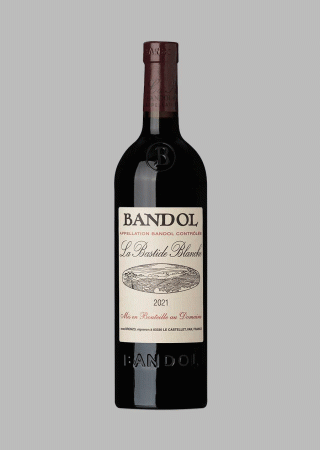
Art.nr. 226201
La Bastide Blanche Bandol
Nyanserad animalisk doft med fatkaraktär, inslag av plommon, björnbär, torkade örter, vitpeppar och mörk choklad. Läs mer…